OPENING QUESTIONS: If you want/need to retake the waves terms test for the 3rd and final time, go HERE (I will enable it shortly after class starts)
LEARNING TARGET: Review
WORDS O' THE DAY:
- frequency (waves/second or waves/minute)
- period ("seconds/wave or minutes/wave")
- amplitude (wave height)
- wavelength (distance from crest to crest)
- crest (the highest point of the wave)
- trough (the lowest point of the wave)
- speed = (wavelength x frequency. NOTE: (meters/
wave) x (waves/sec) = meters/sec - tsunami
- subduction zone
TSUNAMI WAVE EQUATION:
WORK O' THE DAY:
Here's a recap of yesterday's review:
Ocean Waves:
- MegaTsunami
- Tsunami
- 'Regular' Ocean Waves
- Rogue Waves
Each of those has specific wave characteristics that you should MUST know.
1. MegaTsunami For our classroom purposes we have defined those to be tsunami waves with an amplitude of 50 M or more
- Cause: Mega events that dump a huge amount of energy into the ocean in a very short amount of time such as: mega-landslides, massive ice-shelf collapses and asteroid impacts
- Wave characteristics: same/similar to 'regular' tsunami except for amplitude
2. Tsunami
Cause: Landslides, earthquakes (especially subduction zone events for massive tsunami) and underwater volcanic eruptions
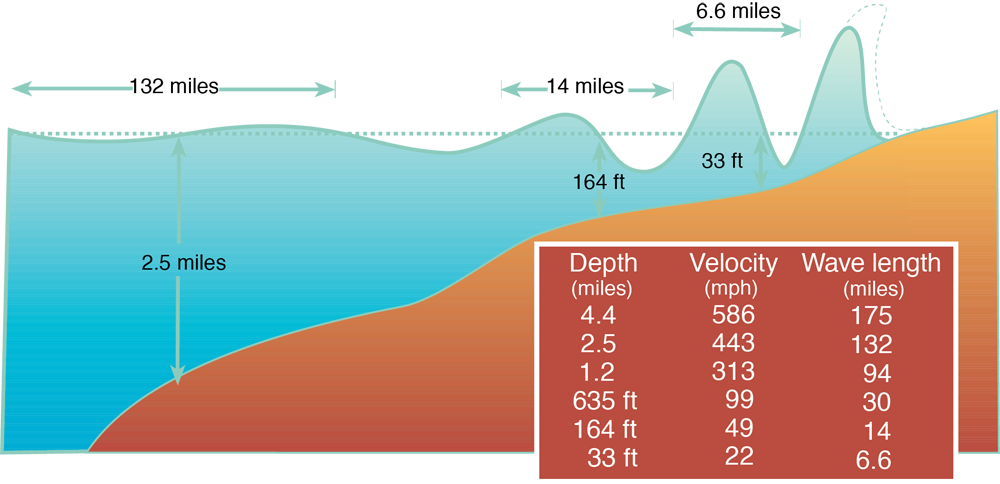
Wave characteristics (you must be able to compare the tsunami wave characteristics at the beach with those in the deep open ocean. You should also have a VERY good idea of wave characteristics of a small amplitude tsunami due to your extensive work on our graphing project):
3. Regular Ocean Waves
Cause: Wind. Big Wind + Big Time + Big Area = BIG WAVES
Wave characteristics (you must be able to compare the tsunami wave characteristics at the beach with those in the deep open ocean. You should also have a VERY good idea of wave characteristics of a small amplitude tsunami due to your extensive work on our graphing project):
4. Rogue Waves
Cause: Some combination of existing ocean waves with currents and tides although the exact mechanism is still largely unknown (but is being studied intensely)
Wave characteristics: Amplitude 2x or 3x surrounding waves. No frequency, no period, no wavelength but speed can be measured.
5. Tidal Bores - Not part of our curriculum so you won't be tested on those.
Cause: Tides
We'll do our 'regular' review of creating test questions today